

MSP multi-tenant with Vector
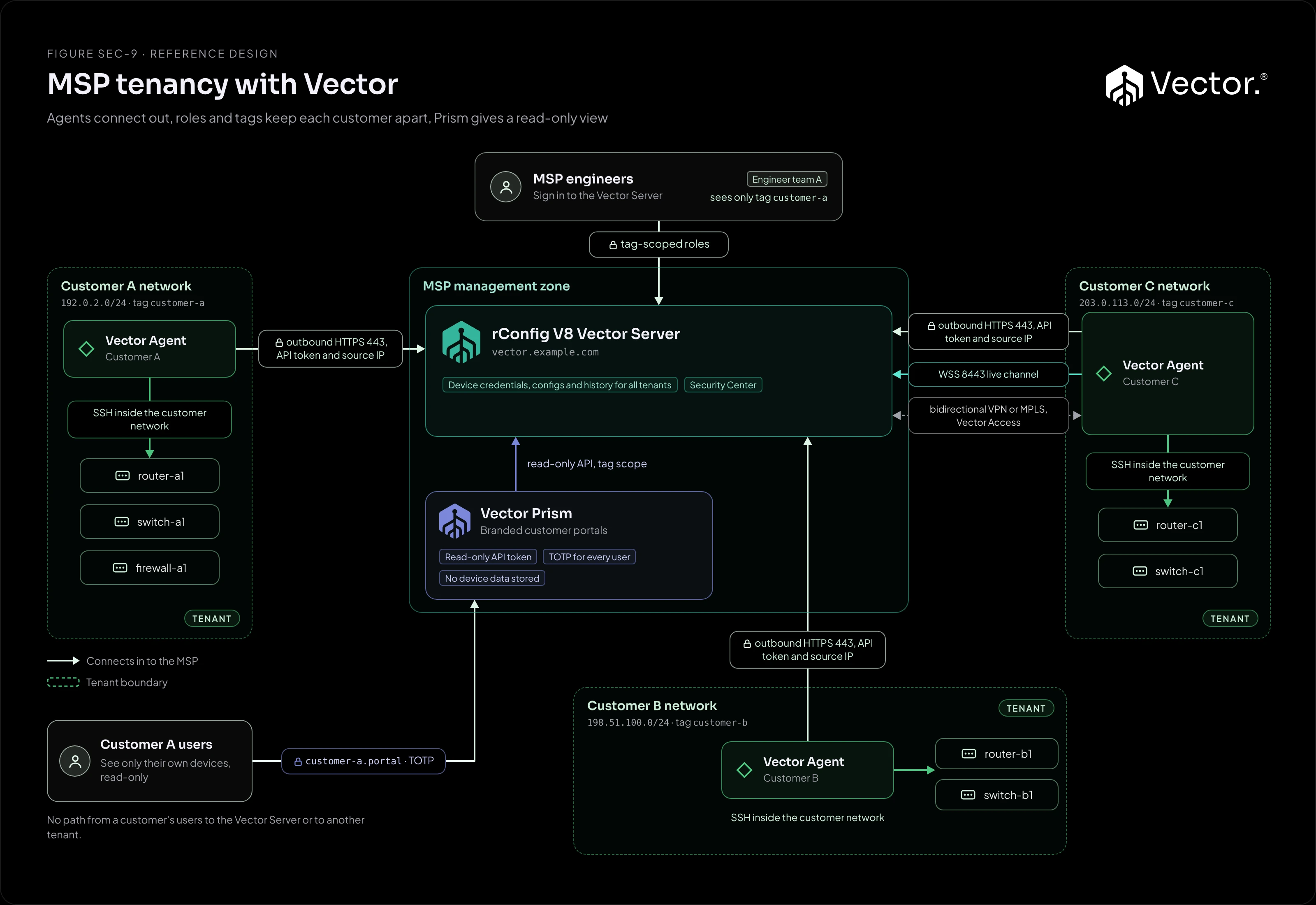
An MSP holds the credentials and configurations of many customers in one place, so the questions change: what keeps one customer’s data and devices away from another’s, what crosses each customer’s edge, and who at the MSP can see what. This design answers them with the parts Vector already has: an agent in each customer network, tag-scoped roles on the Vector Server, and Vector Prism for customers who want to see their own data. The architecture itself is covered in the Vector guides; this page looks at it from the security side.
Who it suits
- MSPs running one Vector Server for many customers (Figure 2 or Figure 3), or a server per country (Figure 1).
- MSPs whose customers ask for evidence of separation, or want a read-only view of their own configurations.
The design
| Part | Lives where | Security role |
|---|---|---|
| Vector Server | MSP management zone | System of record for every tenant: device credentials, configurations, change history, compliance results. |
| Vector Agent | Inside each customer network | Collects from that customer’s devices only. Authenticates to the server with an API token and its source IP. |
| Tags and tag-scoped roles | On the Vector Server | Each customer’s devices carry that customer’s tag; a role scoped to the tag sees only those devices and their backups. |
| Vector Prism (optional) | MSP infrastructure | Customer-facing, read-only portal. Each customer is a team mapped to its tags. |
Trust boundaries and what crosses them
Customer edge
In the default secure unidirectional mode, the agent opens an outbound HTTPS connection to the Vector Server and nothing enters the customer network. The agent picks up jobs over that connection, connects to the customer’s devices over SSH from inside the customer network, and sends the results back. The device credentials for each job come from the Vector Server over the same connection, and the agent masks them in its own logs.
Bidirectional mode (VPN, MPLS or a private WAN) adds a routed path from the MSP into the customer network. That enables Vector Access and hub-initiated operations, and it is a bigger promise to the customer: the MSP can now start sessions into their network. Choose it per customer, not by default. See Connectivity.
| Flow | Direction | Carries |
|---|---|---|
| Agent to Vector Server | Outbound from the customer, HTTPS (443 or the configured port) | Jobs, device credentials for those jobs, configurations and results |
| Agent to Vector Hub | Outbound from the customer, WSS on 8443 | The live channel, if enabled for that agent |
| Agent to devices | Inside the customer network, SSH | Device sessions |
| Vector Server to customer | Inbound to the customer, bidirectional mode only | Vector Access and hub-initiated operations |
Between tenants
Customers share a Vector Server, so separation on the server is logical, not physical:
- Agents: each device is assigned to its own customer’s agent, and each agent has its own token and source IP. A token taken from one customer’s agent host works only from that host’s address.
- Tags: give every customer exactly one tag of its own and apply it to every one of its devices. Tags drive both roles and Prism, so a missing tag hides a device from the people who should see it, and a wrong tag shows it to the wrong ones.
- Roles: MSP engineers who work for one customer get a role scoped to that customer’s tag. See tag-scoped roles.
Where contracts or law require physical separation, use a Vector Server per country or per customer group (Figure 1). Configuration data then stays on that region’s server.
MSP staff
Vector Access sessions are opened from the Vector Server’s command line and can be recorded to a transcript with an audit entry. Device credentials are resolved on the server and never printed or logged. Decide which engineers get shell access to the Vector Server, because that is who can open sessions into customer networks. See Vector Access.
Customer users and Prism
Customer users never get a Vector login. In Prism, each customer is a team mapped to its tags, the scope is enforced on every request, and an empty mapping shows nothing. Prism reads from Vector with a single read-only API token, so it can’t change anything in Vector or reach a device. Every Prism account must enrol TOTP. See Co-managed MSP with Vector Prism.
Where Security Center runs
Security Center runs on each Vector Server and checks that server. It doesn’t inspect agents or Prism, so harden their hosts separately and keep the agent software current.
| Part of the design | Checks |
|---|---|
| Vector Hub root actions kept narrow | runtime.vector_hub_helper |
| HTTPS for agents and users, with a trusted certificate | app.url_https, tls.cert_expiry, tls.self_signed |
| Prism’s token, and other API tokens, scoped | tokens.wildcard |
| Device credentials hidden from screens and API responses | data.mask_credentials |
| MFA for MSP administrators | accounts.mfa |
| Failures reach the on-call team | integrations.alert_channels |
Agents need a trusted certificate on the Vector Server: self-signed certificates are not supported for agents. See Adding agents.
Trade-offs
- One server for every customer, or a server per region or group. One server is simpler and gives one pane. More servers give physical separation and smaller blast radius, at the cost of more to run.
- Outbound only, or bidirectional per customer. Outbound only asks nothing of the customer’s firewall and lets the MSP start nothing inside it. Bidirectional adds Vector Access and real-time operations, and a routed path the customer has to accept.
- Prism or exports. Prism gives customers self-service with a tight, read-only scope and its own audit trail. Sending exports by hand avoids another system but puts the scoping on a person.